
Nobody buys tiles to think about lab tests. You want a floor that looks good and doesn’t fall apart the first monsoon. But here’s the twist: one small number, buried on a spec sheet, decides almost everything about how your tiles will age. That number is water absorption.
This guide breaks down what water absorption of tiles really means, how the test works, and how to read the rate before you place an order. No fluff, no invented statistics — just the standards manufacturers and labs actually use.
What Water Absorption Means, in Plain Language
Every ceramic tile has tiny pores inside its fired body. During manufacturing, clay is pressed and fired at high temperatures. The more the tile vitrifies (turns glass-like) during firing, the fewer open pores remain, and the less water it soaks up.
Water absorption is simply the percentage of water a dry tile absorbs by weight after it’s soaked. A tile that gains 0.3% of its dry weight in water has low absorption. A tile that gains 8% has high absorption, and it will act more like a sponge than a shield.
This single figure predicts a lot: frost resistance, stain resistance, strength, and how well the tile survives being installed outdoors or in a wet bathroom. Low absorption tiles are basically the introverts of the ceramic world — they don’t let much in, and that’s exactly the point.
The Water Absorption Test for Tiles: How It’s Actually Done
The internationally recognised water absorption test for tiles is defined in ISO 10545-3, the standard published by the International Organization for Standardization for ceramic tile testing. It’s part of a broader ISO 10545 series that covers everything from tile dimensions to breaking strength.
Here’s the process in short:
- Tile samples are dried completely and weighed.
- The samples are placed in a vacuum chamber and soaked in water so that water fills the open pores.
- The tiles are weighed again once saturated.
- The weight difference is calculated as a percentage of the original dry weight.
Older versions of the standard allowed a boiling-water method too, but the 2018 revision of ISO 10545-3 moved to the vacuum method only, since it fills pores more thoroughly and gives a more consistent reading. In the United States, labs commonly reference ASTM C373 for the same purpose, using a similar boil-and-weigh approach. Either way, the goal of the tile water absorption test stays the same: measure how porous the fired body really is, not how it looks on the surface.
If a supplier can’t produce a test report referencing one of these standards, treat the “porcelain” or “vitrified” label on the box as a suggestion, not a fact.
Ceramic Tile Water Absorption Rate: How Tiles Get Classified
Once the absorption percentage is known, tiles get sorted into groups. The global reference here is ISO 13006, which classifies ceramic tiles by both their forming method (pressed or extruded) and their water absorption rate. Most Indian floor and wall tiles are dry-pressed, which places them in the “Group B” category of this standard. India’s own tile standard, IS 15622, is harmonised with ISO 13006, so the classification groups line up.
Here’s how the ceramic tile water absorption rate breaks down for dry-pressed tiles:
| Group | Water Absorption | Common Name | Typical Use |
|---|---|---|---|
| BIa | ≤ 0.5% | Porcelain / fully vitrified | Bathrooms, kitchens, outdoor, high-moisture areas |
| BIb | 0.5% – 3% | Vitreous | General flooring, balconies, low-moisture zones |
| BIIa | 3% – 6% | Semi-vitreous | Dry indoor floors, moderate traffic |
| BIIb | 6% – 10% | Semi-vitreous (higher) | Dry indoor walls |
| BIII | Above 10% | Non-vitreous | Dry wall cladding only, never wet areas |
Notice something funny here: “porcelain” isn’t a marketing word under this standard, it’s a technical threshold. A tile only earns that label if lab testing confirms water absorption of ceramic tiles at or below 0.5%. Everything above that is a different animal, no matter what the box says.
Vitrified Tiles Water Absorption: Where They Sit
This is where a lot of buyers get confused, understandably. “Vitrified” and “porcelain” often get used interchangeably in Indian tile shops, but they’re not identical.
Technically, vitrification is the process, and vitrified tiles water absorption can range anywhere from under 0.5% to about 3%, depending on how much the clay body has fused during firing. If you’re browsing our full range of vitrified tiles, it’s worth checking this figure for each collection before you commit. Fully vitrified tiles (BIa, under 0.5%) are what the rest of the world calls porcelain. Tiles in the 0.5% to 3% range are still called vitrified in local trade, but sit one notch above true porcelain in porosity.
Practically, this means two tiles both labelled “vitrified” in a showroom could behave quite differently once installed. One might be fine on a balcony that gets rained on for four months a year. The other might not be. Asking for the actual water absorption of vitrified tiles — the number, not the label — is the only way to know for sure.
Water Absorption of Ceramic Wall Tiles vs Floor Tiles
Not every tile in your home needs the same absorption rating, and this is genuinely good news for your budget.
Wall tiles in dry areas, like a living room accent wall, can tolerate a higher water absorption of ceramic wall tiles because they’re rarely soaked. Many wall tiles fall in the semi-vitreous range and perform perfectly well for years.
Floor tiles are a different story, especially in bathrooms, kitchens, balconies, and anywhere near a water source. Here, low absorption isn’t a luxury, it’s structural insurance. Water that seeps into a porous tile can freeze and expand in colder climates, or simply weaken the tile’s bond with the substrate over time in humid ones. For these zones, sticking to BIa or BIb groups is the safer, less regretful choice.
Why the Water Absorption Test on Tiles Actually Matters for Buyers
It’s easy to treat this as technical trivia that only matters to engineers. It doesn’t. Here’s what a low result on the water absorption test on tiles actually buys you:
- Fewer stains. Porous tiles pull in spilled turmeric, oil, and coffee before you can wipe it up.
- Less mold and bacteria. Moisture trapped inside a tile is a five-star hotel for microbes.
- Better frost performance. In colder regions, trapped water that freezes can crack a tile from the inside out.
- Longer lifespan. Tiles that don’t swell and shrink with moisture keep their bond with the adhesive and grout much longer.
- Lower long-term cost. Replacing cracked or stained tiles a few years in costs more than paying slightly more for the right absorption class upfront.
None of this is marketing spin. It’s simple physics: less porosity, less pathway for water, dirt, and microbes to get in. Pairing the right absorption class with routine care goes a long way too — our maintenance tips for long-lasting vitrified tiles cover the everyday habits that keep this benefit intact for years.
How to Read a Water Absorption Spec Sheet
When a supplier hands you a technical data sheet, look for a line that reads something like “Water Absorption (ISO 10545-3): 0.08%” or “E ≤ 0.5%.” That’s the number that matters more than the finish, the pattern, or the showroom lighting.
A few honest tips:
- If the sheet shows no test standard next to the number, ask for one. A number without a method behind it is just a guess.
- Compare tiles using the same test standard. ISO 10545-3 and ASTM C373 use different soak methods, so results aren’t always perfectly identical, though both are reliable within their own systems.
- For wet or outdoor areas, treat anything above 3% absorption as a compromise, not a solution.
Porcelain vs Ceramic vs Vitrified: Quick Comparison
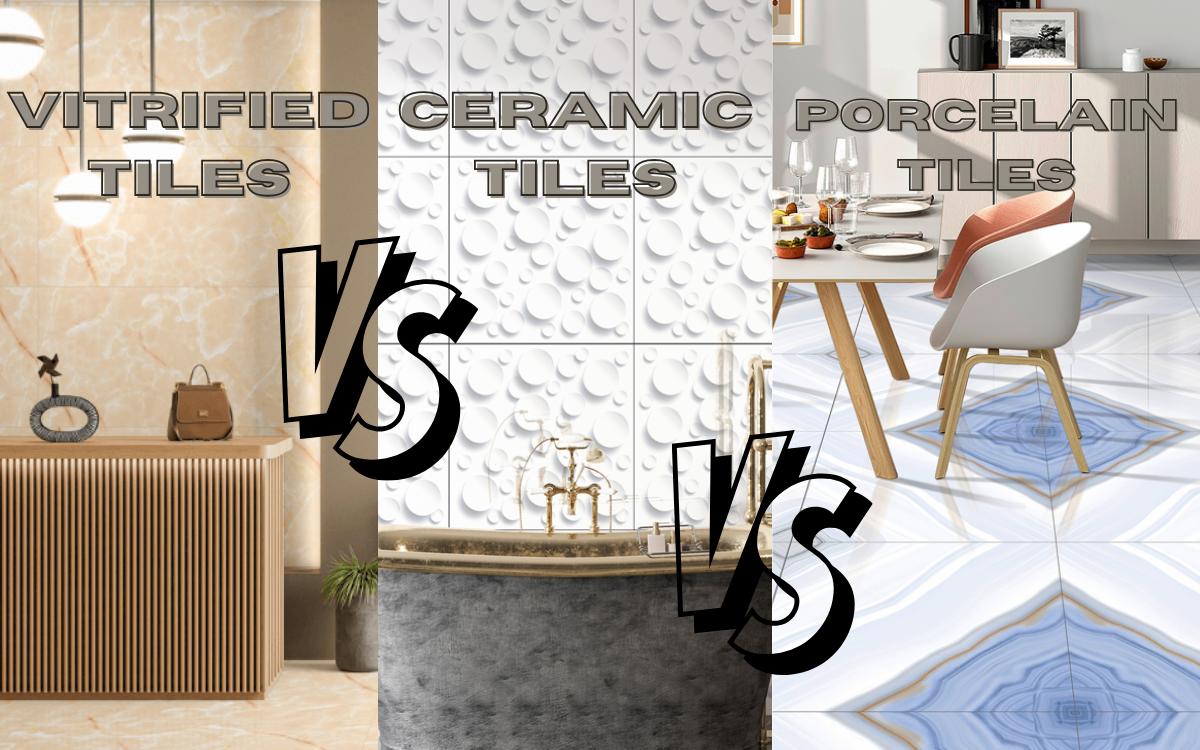
For a fuller side-by-side beyond just absorption rates, our guide on vitrified tiles vs ceramic tiles vs porcelain tiles walks through strength, cost, and finish differences too. Here’s the quick version:
| Feature | Porcelain (BIa) | Standard Ceramic | Vitrified (BIb range) |
|---|---|---|---|
| Water Absorption | ≤ 0.5% | 3% – 7% (typical) | 0.5% – 3% |
| Best For | Wet areas, outdoors | Dry indoor walls/floors | General flooring |
| Density | Very high | Moderate | High |
| Frost Resistance | Strong | Weak | Moderate to strong |
For a deeper look at how porcelain specifically performs across bathrooms, kitchens, and outdoor spaces, our porcelain tiles water absorption guide breaks it down room by room.
FAQ’s
What is a good water absorption rate for tiles?
For wet or outdoor areas, aim for 0.5% or lower (Group BIa). For dry indoor spaces, up to 3% is generally acceptable.
How is the water absorption of tiles tested?
Labs dry the tile, weigh it, saturate it with water under vacuum per ISO 10545-3 (or boil it per ASTM C373), and measure the weight gain as a percentage.
Do all vitrified tiles have less than 0.5% water absorption?
No. Vitrified tiles can range up to 3%. Only tiles at or below 0.5% qualify as fully vitrified, or porcelain, under ISO 13006.
Can I use high-absorption tiles in a bathroom?
It’s not recommended. Tiles above 3% absorption are better suited to dry areas, since moisture exposure over time can cause staining, mold growth, and cracking in colder climates.